

A semaglutide peptide price on a vendor page is only comparable once you convert it to cost per milligram and add shipping. A 5 mg vial at one price and a 10 mg vial at another tell you nothing until you divide. Published research found the average price of 5 mg of semaglutide sold online "for research purposes" was $181 in a 2025 peer-reviewed study, and listings today run across a wide range. We built PepSweep to do that division continuously, so you can see the spread at a glance.
This guide shows how to compare listings fairly, what moves the price, and how research-vial prices relate to the self-pay prices of FDA-approved semaglutide medicines.
TL;DR
- Compare semaglutide listings by cost per milligram, never by vial price, and include shipping and any discount threshold.
- Vial size, order quantity, shipping rules and promo codes explain most price gaps between sellers.
- FDA-approved semaglutide has published self-pay prices: Wegovy pills start at $149/month, per the manufacturer's 2026 cost page.
- Research-labeled products are not approved drugs, and a low price says nothing about purity, so read each seller's testing documentation as part of the comparison.
- PepSweep normalizes live vendor prices to cost per milligram and flags listings you must check on the vendor's own page.
Table of Contents
- Why the sticker price misleads
- How to compare semaglutide peptide prices fairly
- What explains the price differences
- How research-vial prices relate to approved semaglutide prices
- What U.S. rules say about research-labeled semaglutide
- Compare live prices in one place
- Before you buy: a short checklist
- FAQ
- Sources
Why the sticker price misleads
Sellers list semaglutide in 2 mg, 5 mg, 10 mg and larger vials. A lower sticker price often just means a smaller vial. If one vial is $39 and holds 5 mg, you pay $7.80 per milligram. If another is $65 and holds 10 mg, you pay $6.50 per milligram. The cheaper-looking vial is the more expensive product.
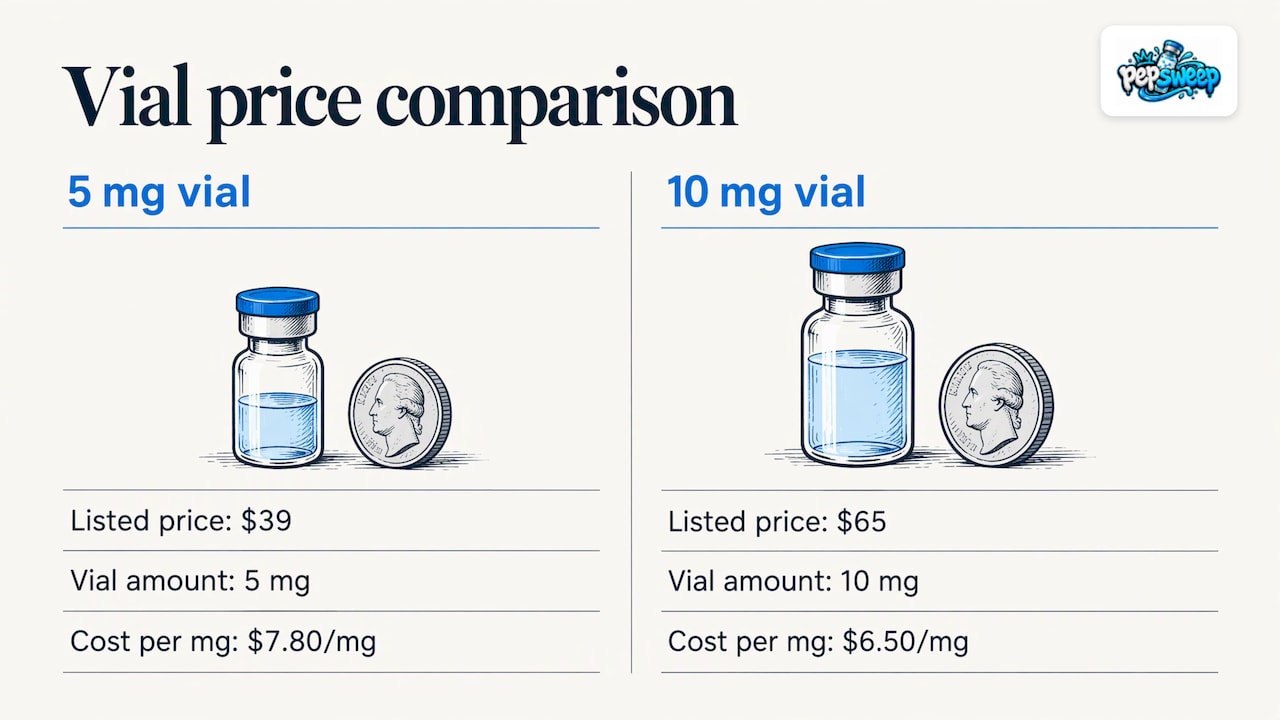
The same trap appears in kit pricing (a "10-vial kit" price divided by vials, then by milligrams per vial) and in tiered pricing, where the price per vial drops as you add vials to the cart. Search results for this keyword mix all of these formats, which is why a raw price list is hard to read.
How to compare semaglutide peptide prices fairly
The method is simple arithmetic, but it has to be applied the same way to every listing.
- Confirm the compound and the amount. Check that every listing is semaglutide, and note the total milligrams in the vial or kit. Watch for blends and for products named "GLP-1" without a clear compound.
- Divide price by total milligrams. A $65 vial of 10 mg is $6.50/mg. A kit of 10 vials at 5 mg each is 50 mg, so divide the kit price by 50.
- Apply the real quantity price. Many shops discount per vial when you buy several. Use the price for the quantity you actually need, not the headline "from" price.
- Add shipping. Some shops ship free above an order threshold, others charge a flat fee. Divide shipping by total milligrams in the order and add it to the per-milligram figure.
- Subtract valid discount codes. A code that takes a percentage off changes the ranking. Re-run the division after the code.
- Check what the seller documents. Price per milligram ranks cost, not quality. Look at whether the seller publishes batch testing and what it covers.
A worked example
These numbers are illustrative, not live prices.
| Vendor A | Vendor B | |
|---|---|---|
| Vial size | 5 mg | 10 mg |
| Vial price | $39 | $65 |
| Vials ordered | 2 | 2 |
| Product subtotal | $78 | $130 |
| Shipping | $12 | Free over $100 |
| Total | $90 | $130 |
| Total milligrams | 10 mg | 20 mg |
| Cost per milligram | $9.00 | $6.50 |
Vendor A looks $52 cheaper at checkout, yet costs $2.50 more per milligram. If you need 10 mg, the fair question is what Vendor B charges for a single 10 mg vial. Only normalizing lets you ask it.
Doing this across dozens of shops by hand means reopening each page, because prices and thresholds change. That is the repetitive part we automate: our scanner checks vendor listings and converts them to cost per milligram.
What explains the price differences
Several factors produce the gap between the cheapest and the most expensive listing of the same compound.
Vial size. Larger vials usually cost less per milligram, but only help if you need that amount. The cheapest per-milligram option is not the cheapest purchase for a small need.
Order quantity. Tiered pricing is common. One seller's wholesale page, for example, prices a kit of vials lower per vial than a single vial, and the discount grows with the number of kits. Always price the quantity you will really buy.
Shipping rules. Free-shipping thresholds, such as free U.S. shipping above a set order total, can push a small order's real cost above a rival's. They also encourage buying more than you planned.
Discount codes. Percentage-off codes change the ranking between vendors. Codes expire or change terms, so a comparison is only as good as its date.
Testing and documentation claims. Sellers advertise purity and third-party testing. Those claims add to cost at some shops, but a label is not verification. In the 2025 study cited above, a laboratory assessment of samples from three U.S. sellers found purity of 7% to 14% against a promised level near 99%, and the measured semaglutide content differed from the label. The takeaway for your comparison: treat a very low price per milligram and an unverifiable purity claim as two separate things to assess, and read the certificate of analysis a seller publishes, including which lab issued it and which batch it covers.
Supplies. The same study noted that only 3 of the sites it reviewed included the diluent needed to dissolve the powder. If a listing excludes supplies you need, they are an additional cost.
How research-vial prices relate to approved semaglutide prices
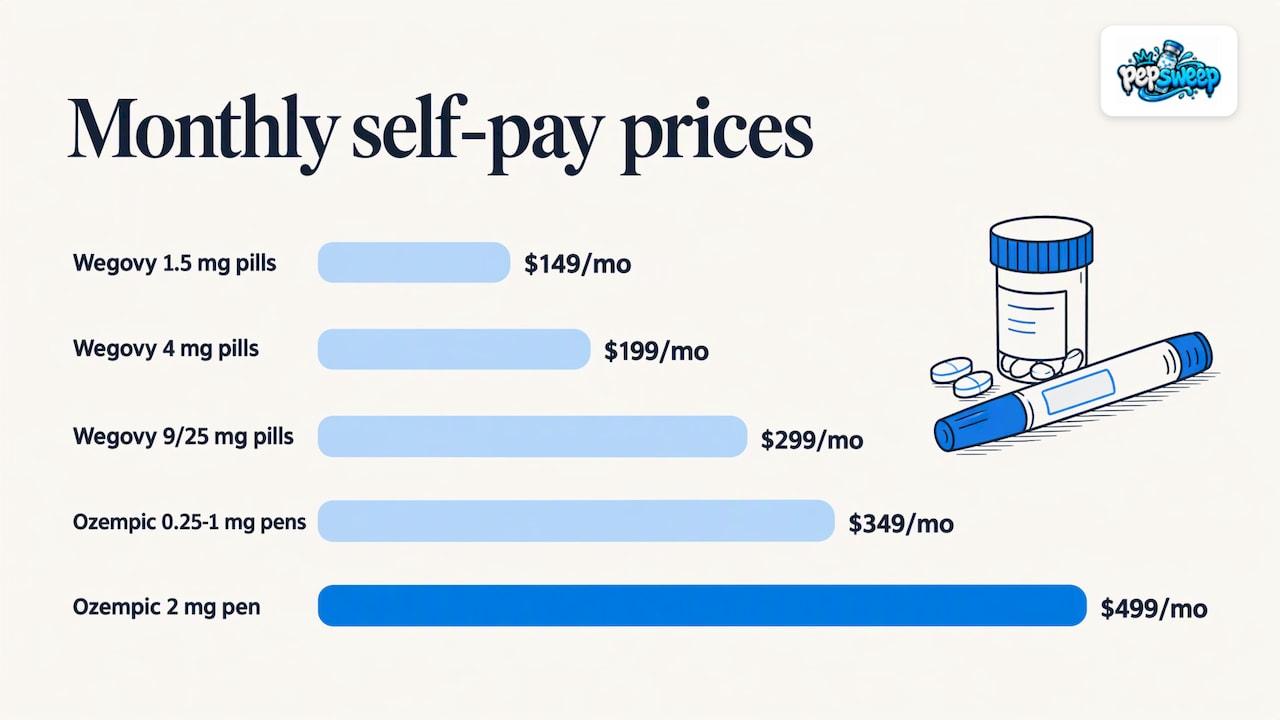
People searching for a semaglutide peptide price often want to know how it stacks up against the medicine. The two are not interchangeable products. FDA-approved semaglutide is a prescription drug sold with dosing instructions, while research peptides are labeled for laboratory use. Still, the approved prices are published and give a useful reference for what the drug costs a self-pay patient.
As of the manufacturers' 2026 cost pages:
- Wegovy self-pay pills are $149/month (1.5 mg), $199/month (4 mg) and $299/month (9 mg or 25 mg). New patients using the savings offer pay $199/month for the first two fills of the 0.25 mg or 0.5 mg pen through December 31, 2026, then $349/month, and the 7.2 mg HD pen is $399/month. Commercially insured patients may pay as little as $25/month, with a maximum savings of $100/month.
- Ozempic self-pay pens are $349/month for 0.25 to 1 mg doses and $499/month for the 2 mg pen, with pill prices of $149, $199 and $299 per month for 1.5, 4 and 9 mg.
- Drugs.com reports that eligible Medicare patients prescribed Wegovy for weight management may pay $50 per month through the Medicare GLP-1 Bridge Program, which began nationwide on July 1, 2026. Self-pay purchases are processed outside insurance and do not count toward deductibles or out-of-pocket limits.
These are published prices for a given period and change when the manufacturer updates its offers, so confirm them on the manufacturer's page. Whether a prescription medicine is right for you is a question for your doctor or pharmacist.
What U.S. rules say about research-labeled semaglutide
Two facts matter when you read any price page.
First, FDA declared the semaglutide shortage resolved on February 21, 2025, which ended the broad basis for compounding copies of the approved drug. The Kansas State Board of Pharmacy's August 2026 statement says compounding is now permissible only for a drug on the FDA shortage list or a patient-specific change producing a significant difference, and that semaglutide salt forms such as sodium and acetate may not be used in compounded products.
Second, the same legal summary notes that FDA says research-use labeling does not change a product's intended use as a drug, and that the agency has warned online sellers about unapproved products labeled for research use. Research peptides are sold for laboratory research, not for human use. If you are a patient, talk to a licensed prescriber about approved options. If you are a lab buyer, keep your purchase documentation and confirm your institution's procurement rules.
Compare live prices in one place
PepSweep is a price comparison tool for peptides. It scans vendor listings, compares live and manually verified prices across 45 research compounds, and normalizes every offer to cost per milligram, applying the SWEEP code so you compare like for like. The scanner distinguishes prices it has synced from listings you need to check directly with the vendor. We do not sell or endorse the products; we show the prices and link you to the sellers.
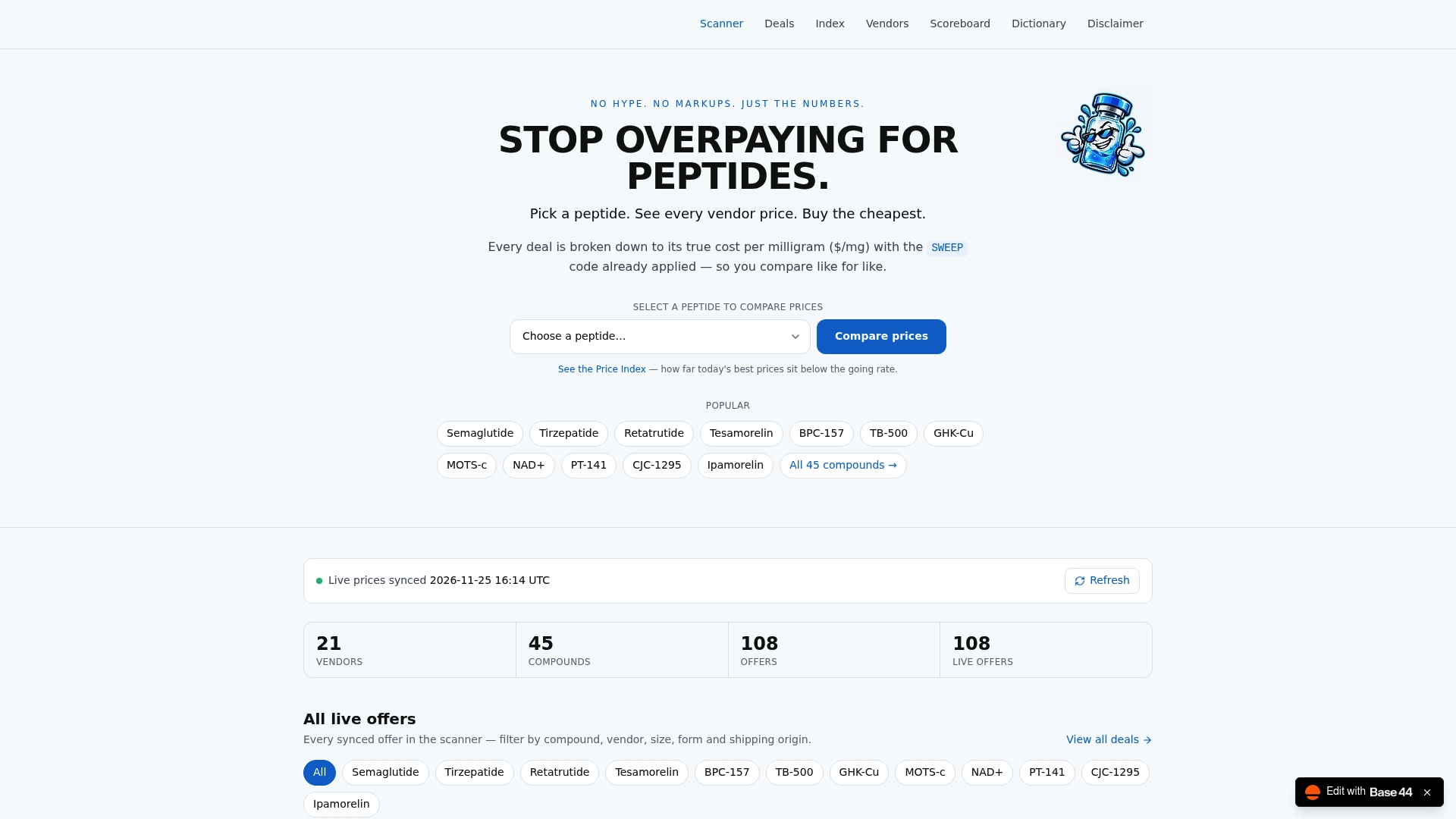
To see where semaglutide and other GLP-1 compounds sit right now, open the GLP-1 price index, or start from the real-time peptide price scanner.
Before you buy: a short checklist
- Is the cost per milligram calculated on the exact quantity and with shipping?
- Does the code you plan to use still apply at checkout?
- Does the listing say whether the price is synced or needs checking on the seller's page?
- Does the seller publish batch-specific testing from a named lab?
- Does the order include the supplies you need, or are they extra?
- Does your institution or lab require specific procurement documentation?
FAQ
How much does a semaglutide peptide cost?
Listed prices vary by vial size and seller, so the useful figure is the cost per milligram. A 2025 peer-reviewed study found an average of $181 for 5 mg from sites selling for research purposes. Check a live price index for current figures, since prices move.
How do I compare semaglutide prices between vendors?
Divide each vendor's price by the total milligrams, add shipping, and subtract any valid discount code. Do this for the quantity you plan to buy, because tiered pricing changes the result. PepSweep does the normalization automatically and shows the results side by side.
Is a cheaper semaglutide price per milligram a better deal?
It is cheaper, which is the only thing the number measures. Quality and documentation are separate, so read the seller's batch testing and certificate of analysis alongside the price.
How does research semaglutide pricing compare with Wegovy or Ozempic?
They are different products. Wegovy pills have published self-pay prices of $149 to $299 per month in 2026, and Ozempic pens are listed at $349 to $499 per month self-pay. Research peptides are priced per vial and labeled for laboratory use only.